ef_points
- property EfficientFrontier.ef_points
Generate multi-period Efficient Frontier.
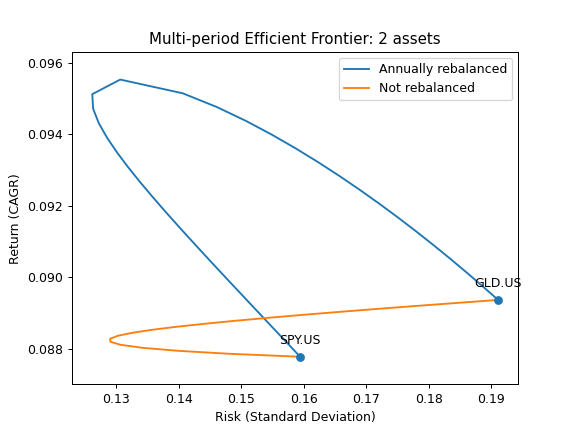
Each point on the Efficient Frontier is a rebalanced portfolio with optimized annual risk for a given CAGR. In case of non-convexity along the risk axis, the second part of the chart is generated, where the maximum risk value is found for each point.
- Returns:
- DataFrame
Table of weights and risk/return values for the Efficient Frontier. The columns:
assets weights
CAGR
Risk (standard deviation)
All the values are annualized.
Examples
>>> ls = ["SPY.US", "GLD.US"]
>>> curr = "USD"
>>> y = ok.EfficientFrontier(
...     assets=ls,
...     first_date="2004-12",
...     last_date="2020-10",
...     ccy=curr,
...     rebalancing_strategy=ok.Rebalance(period="year"),
...     ticker_names=True,  # Use tickers in DataFrame column names.
...     n_points=20,  # Number of points in the Efficient Frontier.
... )
>>> df_reb_year = y.ef_points
>>> df_reb_year[["Risk", "CAGR", "SPY.US", "GLD.US"]].head(5)
       Risk      CAGR    SPY.US    GLD.US
0  0.159403  0.087770  1.000000  0.000000
1  0.157208  0.088178  0.985742  0.014258
2  0.155011  0.088586  0.971065  0.028935
3  0.152814  0.088994  0.955931  0.044069
4  0.150619  0.089402  0.940300  0.059700
To compare the Efficient Frontiers of annually rebalanced portfolios with not rebalanced portfolios it’s possible to draw 2 charts: rebalancing_strategy=ok.Rebalance(period=’year’) and ok.Rebalance(period=’none’).
>>> import matplotlib.pyplot as plt
>>> y.rebalancing_strategy = ok.Rebalance(period="none")
>>> df_not_reb = y.ef_points
>>> fig = plt.figure()
>>> # Plot the assets points using CAGR to match the Efficient Frontier Y-axis.
>>> ax = y.plot_assets(kind="cagr")
>>> # Plot the Efficient Frontier for annually rebalanced portfolios
>>> ax.plot(df_reb_year["Risk"], df_reb_year["CAGR"], label="Annually rebalanced")
>>> # Plot the Efficient Frontier for not rebalanced portfolios
>>> ax.plot(df_not_reb["Risk"], df_not_reb["CAGR"], label="Not rebalanced")
>>> # Set axis labels and the title
>>> ax.set_title("Multi-period Efficient Frontier: 2 assets")
>>> ax.set_xlabel("Risk (Standard Deviation)")
>>> ax.set_ylabel("Return (CAGR)")
>>> ax.legend()
>>> plt.show()